Welcome to

Armenia

Land of Ancient Mountains, Rich History & Warm Hearts

Explore

Armenia at a Glance

A small but mighty nation nestled in the South Caucasus, at the crossroads of Europe and Asia. Armenia is one of the world's oldest civilizations with a continuous cultural heritage stretching back over 3,500 years.

🏛️

Capital

Yerevan

One of the world's oldest continuously inhabited cities, founded in 782 BC — 29 years before Rome.

🗣️

Language

Armenian

A unique Indo-European language with its own 39-letter alphabet, created in 405 AD by Mesrop Mashtots.

👥

Population

~3 Million

About 3 million in Armenia, but over 7 million Armenians live around the world in the diaspora.

Religion

Christianity

The first nation to adopt Christianity as a state religion in 301 AD — over a decade before the Roman Empire.

💰

Currency

Armenian Dram (AMD)

The national currency since 1993, symbolizing Armenia's modern independence and sovereignty.

🏔️

Geography

29,743 km²

A landlocked, mountainous country with an average elevation of 1,800 meters above sea level.

Where is Armenia?

Located in the South Caucasus region at the crossroads of Western Asia and Eastern Europe. Armenia borders Georgia to the north, Azerbaijan to the east, Iran to the south, and Turkey to the west.

Capital City
Major Cities
Landmarks

A Brief History

Armenia's history is among the longest of any country in the world. Here are some milestones that shaped this ancient nation.

~3500 BC

Ancient Origins

Early Armenian civilization emerges in the Armenian Highlands. The world's oldest known leather shoe (5,500 years old) and the oldest known winery were found in Armenian caves.

860 BC

Kingdom of Urartu

The powerful Kingdom of Urartu (Ararat) rises in the Armenian Highlands, becoming one of the strongest kingdoms of the ancient Near East, rivaling Assyria.

331 BC

Orontid Dynasty

Following Alexander the Great's conquests, Armenia establishes itself as a distinct satrapy, eventually growing into an independent kingdom under the Orontid dynasty.

95–55 BC

Tigranes the Great

Under King Tigranes II, Armenia expands into a vast empire stretching from the Caspian Sea to the Mediterranean — the largest Armenian state in history.

301 AD

First Christian Nation

Armenia becomes the first country in the world to adopt Christianity as its state religion under King Tiridates III, guided by Saint Gregory the Illuminator.

405 AD

Armenian Alphabet

Mesrop Mashtots creates the Armenian alphabet — 36 unique letters (now 39) — sparking a golden age of Armenian literature, science, and scholarship.

1915

The Armenian Genocide

During World War I, 1.5 million Armenians were systematically killed by the Ottoman Empire in what is widely recognized as the first genocide of the 20th century.

1991

Independence

Following the collapse of the Soviet Union, Armenia declares independence on September 21, 1991, beginning a new chapter as a sovereign republic.

Culture & Traditions

Armenian culture is a vibrant tapestry of ancient traditions, art, music, and cuisine that has survived millennia.
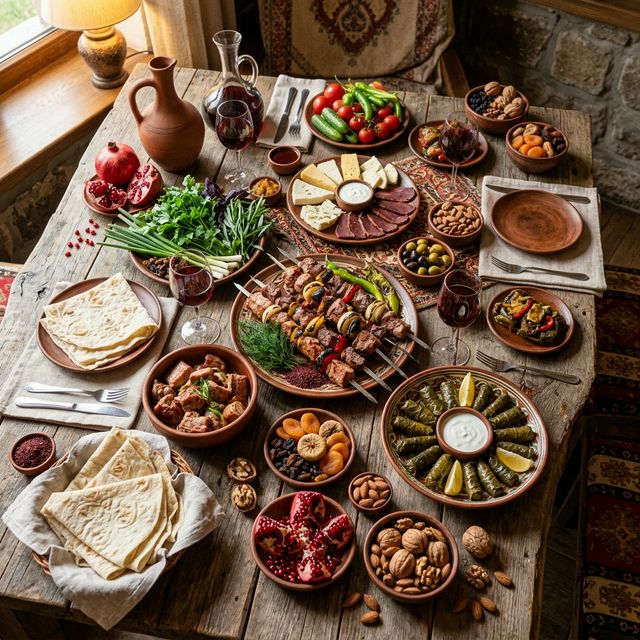
Traditional Armenian cuisine with lavash, dolma, and khorovats

🍽️ Cuisine

Armenian food is a celebration of flavors. Lavash (thin flatbread, UNESCO heritage) is served at every meal. Khorovats (barbecue) is a social tradition. Dolma (stuffed grape leaves), ghapama (stuffed pumpkin), and gata (sweet pastry) are beloved staples. Armenia is also believed to be the birthplace of winemaking, with evidence dating back 6,100 years.

🎵 Music & the Duduk

The duduk, an ancient double-reed woodwind instrument made from apricot wood, produces a hauntingly beautiful sound recognized by UNESCO as a Masterpiece of Intangible Heritage. Its melodies have been used in Hollywood films, including Gladiator and The Last Temptation of Christ.

✍️ The Alphabet

Armenians are deeply proud of their unique alphabet. It's not just a writing system — it's a symbol of national identity and survival. Each letter is believed to correspond to a prayer, and monument statues of each letter stand on a hillside near Artashavan. The alphabet has preserved Armenian thought and faith for 1,600 years.

♟️ Chess

Armenia is one of the few countries where chess is a mandatory school subject. The nation has produced multiple chess world champions and olympiad winners — a remarkable feat for a country of just 3 million people.

🏠 Hospitality

Armenians are renowned for their warmth and hospitality. Guests are treated with the utmost respect — there's a saying: "A guest is sent by God." Expect to be offered coffee, sweets, and sometimes a full meal just for stopping by.
Nature & Landmarks

From snow-capped peaks to ancient monasteries carved into cliffs, Armenia's landscapes are nothing short of spectacular.

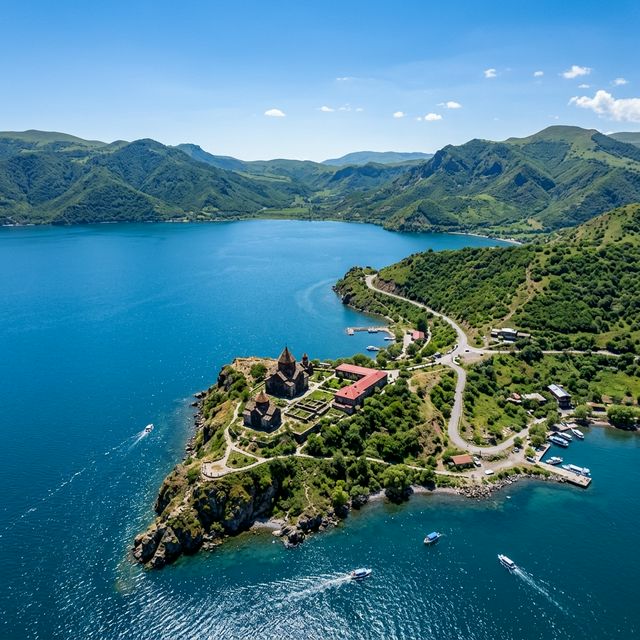
Lake Sevan and Sevanavank monastery in Armenia

Lake Sevan

One of the largest high-altitude freshwater lakes in the world, sitting at 1,900 meters. Known as the "Jewel of Armenia," its turquoise waters and ancient Sevanavank monastery make it a must-visit.

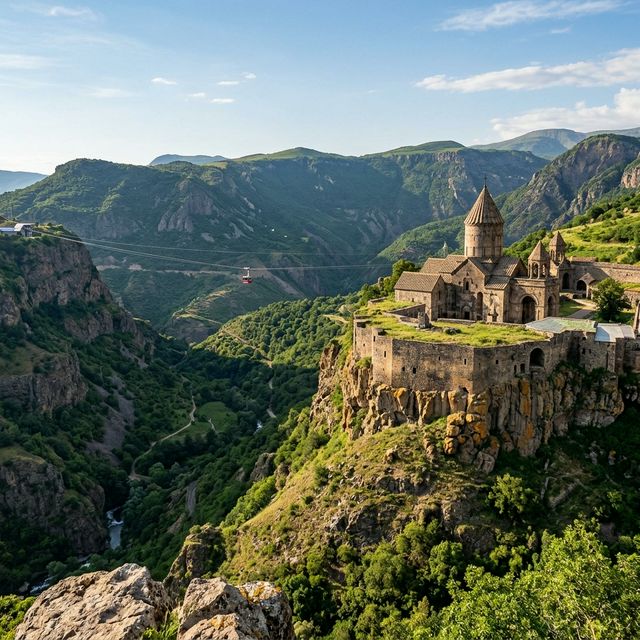
Tatev Monastery perched on a cliff in Armenia

Tatev Monastery

A 9th-century masterpiece perched on the edge of a deep gorge. Home to the world's longest reversible aerial tramway — the "Wings of Tatev" — stretching 5.7 km over a stunning canyon.

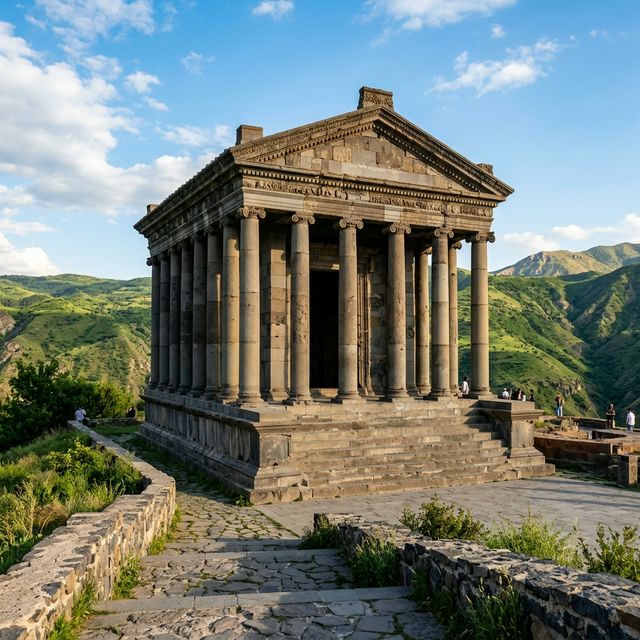
Garni Temple, the last standing Greco-Roman temple in Armenia

Garni Temple

The only standing Greco-Roman colonnaded building in Armenia and the former Soviet Union. Built in the 1st century AD and dedicated to the sun god Mihr, it overlooks a striking basalt gorge known as the "Symphony of Stones."

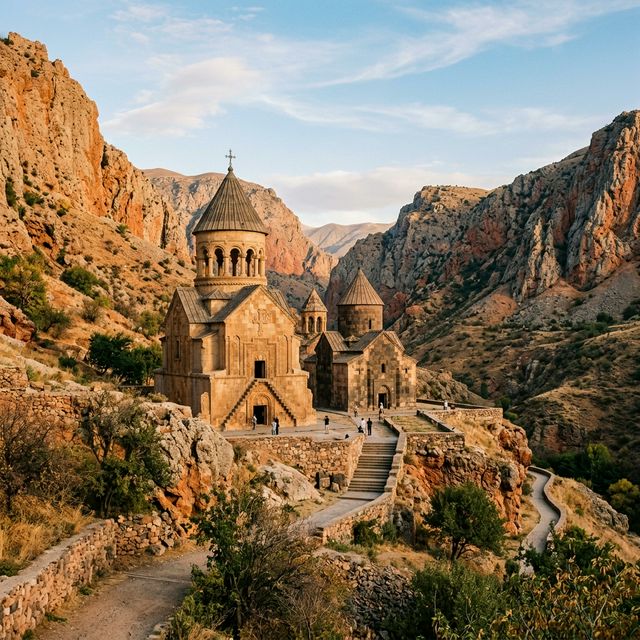
Noravank Monastery surrounded by red cliffs in Armenia

Noravank Monastery

A 13th-century monastery nestled within dramatic red rock canyon walls. Famous for its intricate stone carvings and the breathtaking natural amphitheater of terracotta-colored cliffs surrounding it.

Did You Know?

Here are some fascinating facts that make Armenia truly unique.

0
+ years

of recorded history

0
years

oldest known winery

0
UNESCO

World Heritage Sites

0
m

Mount Aragats peak

🍑

The Apricot Connection

The apricot is Armenia's national fruit. In fact, the scientific name for apricot — Prunus armeniaca — literally means "Armenian plum." Armenians have cultivated apricots for thousands of years.

👟

World's Oldest Leather Shoe

The Areni-1 shoe, discovered in a cave in southern Armenia, is approximately 5,500 years old — making it the oldest known leather shoe in the world, even older than Stonehenge.

♟️

Chess Powerhouse

In 2011, Armenia became the first country to make chess a mandatory subject in elementary schools. The nation consistently ranks among the top chess-playing nations globally.

🌐

Global Diaspora

More Armenians live outside Armenia than inside it. Major diaspora communities thrive in Russia, the United States, France, Lebanon, Argentina, and many other countries.